Modern DDoS attacks do not wait politely at the edge of the network. They arrive as sudden pressure against every fragile assumption in the infrastructure: that inspection can happen after packet admission, that static rules can describe hostile behavior, that centralized appliances can absorb distributed violence, and that the operating system has enough time to decide what is legitimate after the interrupt has already fired.
That model worked when attacks were simpler. It fails against today’s hyper-volumetric floods, reflection campaigns, spoofed session storms, and polymorphic Layer 7 botnets. The failure rarely begins at the application. It begins much earlier, in the expensive gap between packet arrival and packet decision.
The Appliance Bottleneck
Traditional DDoS appliances are usually positioned as powerful boxes at strategic choke points. Traffic flows into the appliance, the appliance inspects it, and filtered traffic continues toward the protected environment. On paper, the architecture is clean. In production, the choke point becomes the liability.
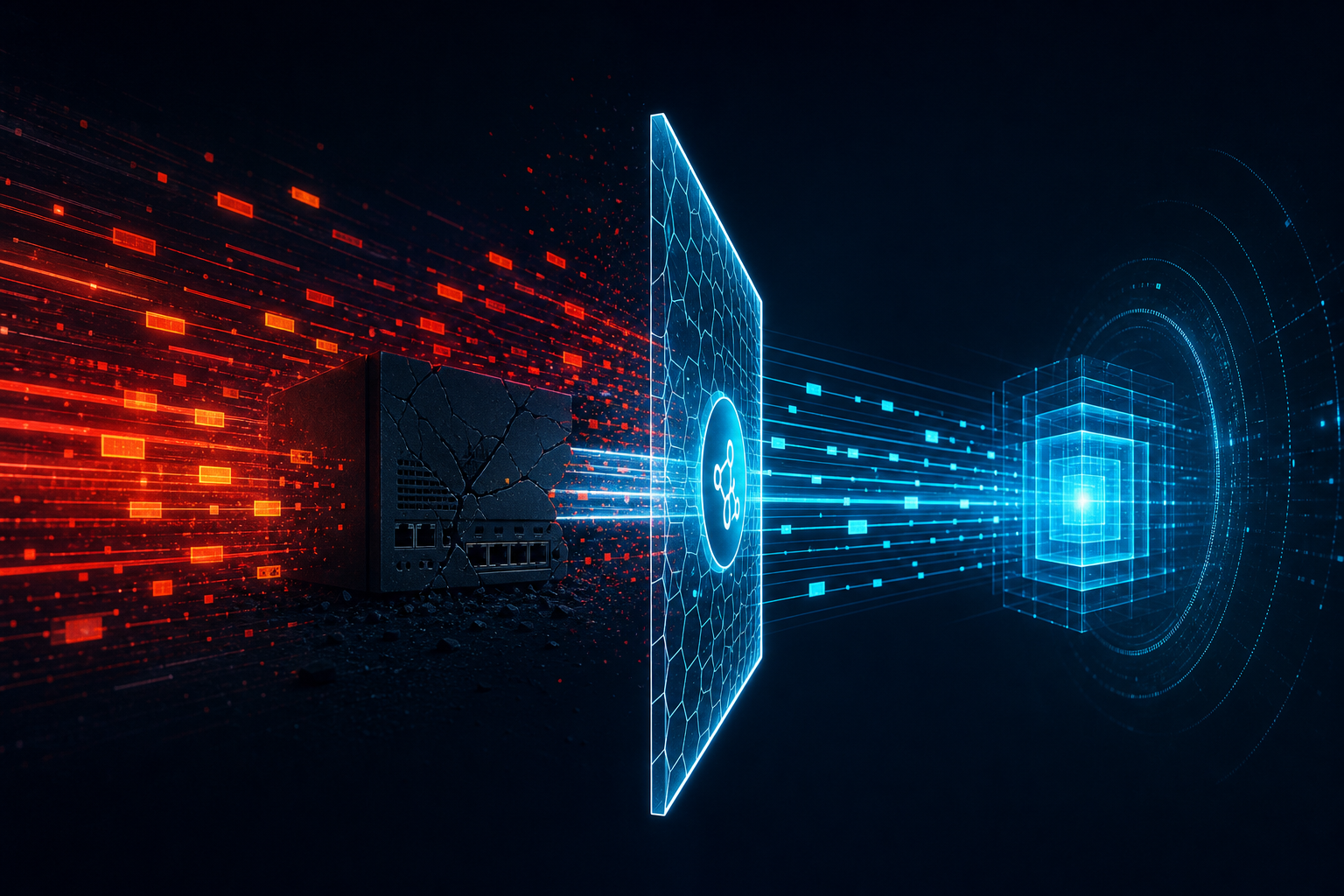
Every packet that reaches a legacy appliance has already consumed routing capacity, interface queue space, interrupt handling, memory bandwidth, and inspection cycles. During normal traffic, that cost is manageable. During an attack, the appliance is forced to spend scarce resources on packets that should never have been allowed to become expensive in the first place.
This is why legacy mitigation often degrades before the origin application sees the first real failure. Packet queues lengthen. Connection tables expand. CPU cores shift from useful inspection to survival work. Rule engines become hot paths. The security layer, intended to protect availability, becomes another component competing for availability.
Static Rules Cannot Understand a Moving Attack
Older defenses depend heavily on thresholds, signatures, and manually tuned access rules. These controls are useful against known patterns, but modern attackers design around them. They distribute traffic across residential networks, rotate headers, vary request timing, spoof session characteristics, and slowly increase intensity until they cross from anomaly into outage.
A static threshold sees volume. It does not understand rhythm. A signature sees a known payload. It does not recognize an evolving campaign. A manual rule can block yesterday’s attack, but it cannot reason about the subtle coordination that makes a botnet artificial even when each individual request appears ordinary.
This is where CoreDetection™ changes the decision model. Instead of treating attacks as fixed patterns, it analyzes behavioral structure: traffic rhythm, source dispersion, protocol fingerprints, recurrence against Attack Memory, and the coordinated deviations that separate organic demand from synthetic pressure. The goal is not simply to block more traffic. The goal is to decide earlier, with higher confidence, before bad packets force the infrastructure into expensive work.
The Kernel Is Already Too Late
The most important architectural shift in DDoS mitigation is deciding where the first security decision happens. If a packet reaches user space before it is classified, the system has already paid a heavy tax. If it reaches the application before it is challenged, the attacker has already moved the battle to the most expensive layer.
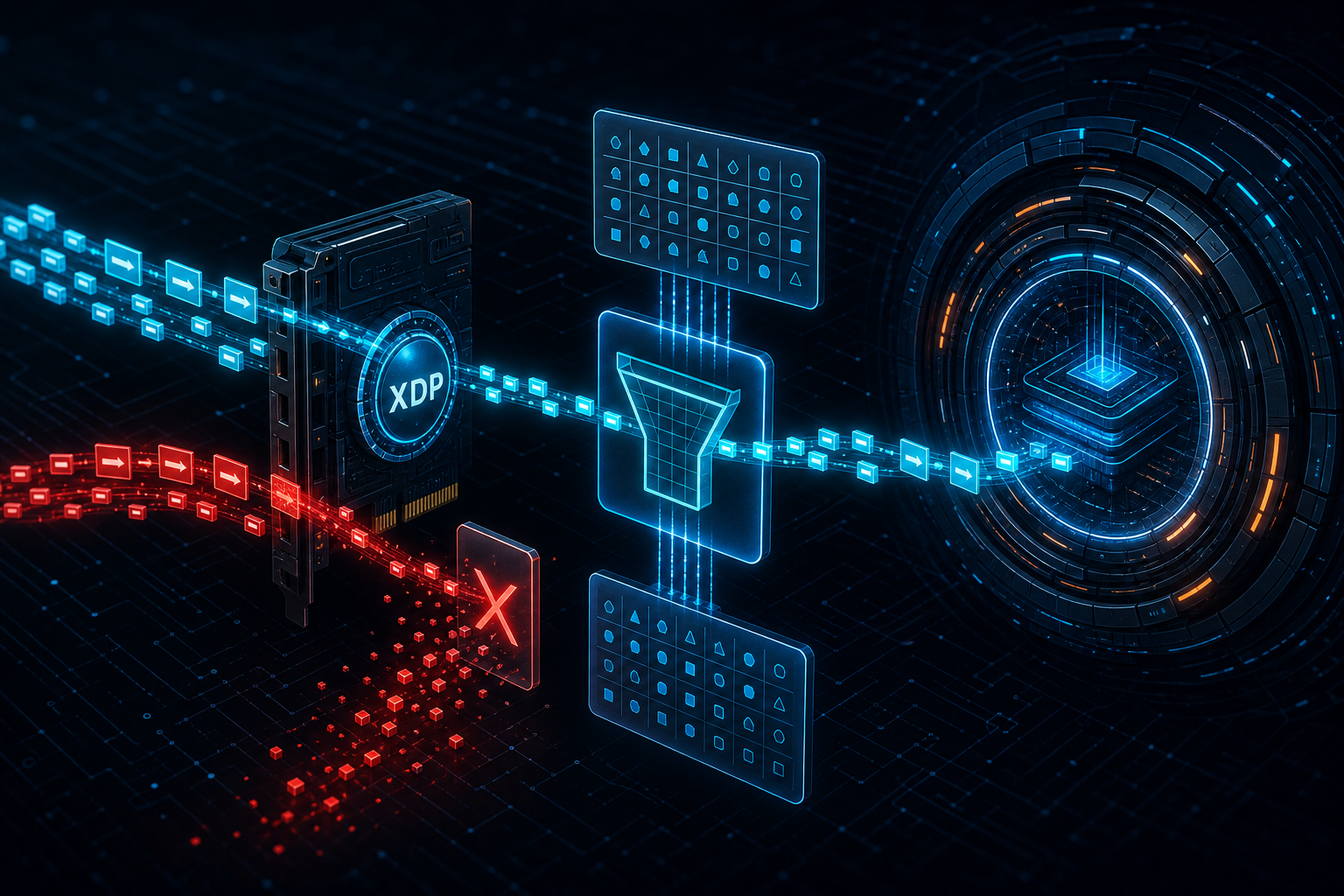
CoreEdge™ moves that decision point down into the Linux networking path with eBPF/XDP, where hostile packets can be evaluated at wire speed before the traditional kernel networking stack performs deeper work. This is not just a performance optimization. It is a security boundary.
By filtering at the earliest viable point, CoreEdge avoids the compounding costs that destroy legacy appliances under pressure. Spoofed TCP sessions can be rejected before they consume state. UDP floods can be shaped before they saturate application-facing queues. Known malicious fingerprints can be neutralized before they travel deeper into the protected network. Clean traffic continues forward with minimal added latency because the mitigation layer is not forcing every packet through a slow, centralized inspection ritual.
Centralized Scrubbing Is Not Enough
Large scrubbing centers are valuable, but centralization alone does not solve modern DDoS risk. When all mitigation depends on dragging traffic through a limited number of inspection points, the architecture inherits distance, congestion, and routing complexity. The larger the attack, the more the system depends on the very chokepoints attackers are trying to overwhelm.
CoreTech’s model is distributed by design. CoreEdge operates as a global data plane, using Anycast and intelligent routing to fracture hostile traffic across regional capacity instead of allowing it to converge into one fragile inspection path. That distribution matters because modern attacks are not local events. They are coordinated pressure systems, assembled from compromised devices, reflection sources, and rented infrastructure across many networks at once.
When mitigation is distributed, attack energy is absorbed closer to where it originates. When classification is fast, hostile packets are discarded before they accumulate downstream cost. When detection is behavioral, the platform can adapt as the attack mutates instead of waiting for an operator to write a new rule under pressure.
The Real Failure Is Architectural
The weakness of traditional DDoS appliances is not that they are underpowered. It is that they defend at the wrong moment. They assume the network can afford to receive, queue, inspect, and forward hostile traffic through heavyweight paths before making a final decision. At modern attack scale, that assumption collapses.
Effective mitigation has to be earlier than the application, earlier than user space, and intelligent enough to identify attacks that do not look identical from one minute to the next. It must combine wire-speed packet enforcement with autonomous behavioral analysis. It must protect latency as aggressively as it protects bandwidth. And it must scale across the network rather than concentrating risk into a single defensive appliance.
That is the reason CoreTech built CoreEdge™ and CoreDetection™ as a unified mitigation architecture. CoreEdge handles enforcement where speed matters most: at the packet path, before malicious traffic becomes operational cost. CoreDetection supplies the adaptive intelligence required to recognize coordinated abuse, remember recurring attack patterns, and generate decisions that static controls cannot produce.
Legacy appliances try to survive the flood. CoreTech’s approach is different: prevent the flood from becoming expensive.
Want to see this in action?
Get a live demonstration of CoreTech's DDoS mitigation platform.