The Problem Every Security Vendor Ignores
There is a hidden architectural truth that the legacy DDoS protection industry has quietly accepted for two decades: their mitigation systems are fundamentally too slow. Not just somewhat slower. Architecturally, catastrophically slow at the most critical moment — when a terabit-scale assault is in full force.
Traditional firewalls and scrubbing appliances operate deep inside the software stack of an operating system. Every single packet, whether it is a legitimate user request or a maliciously crafted flood packet from a botnet, must traverse the same lengthy processing journey through dozens of kernel subsystems before a security verdict is even reached. Under normal conditions, this overhead is merely a performance tax. During an active DDoS campaign generating hundreds of millions of packets per second, it becomes an unavoidable collapse point. The CPU saturates, memory fills, the OS begins dropping packets indiscriminately, and the protection system becomes the attack surface itself. It is an industry-wide architectural vulnerability that virtually every major vendor quietly papers over with marketing language about “terabit capacity.”
CoreTech engineered CoreEdge™ from first principles to eliminate this vulnerability entirely.
An Invisible Wall at the Speed of Silicon
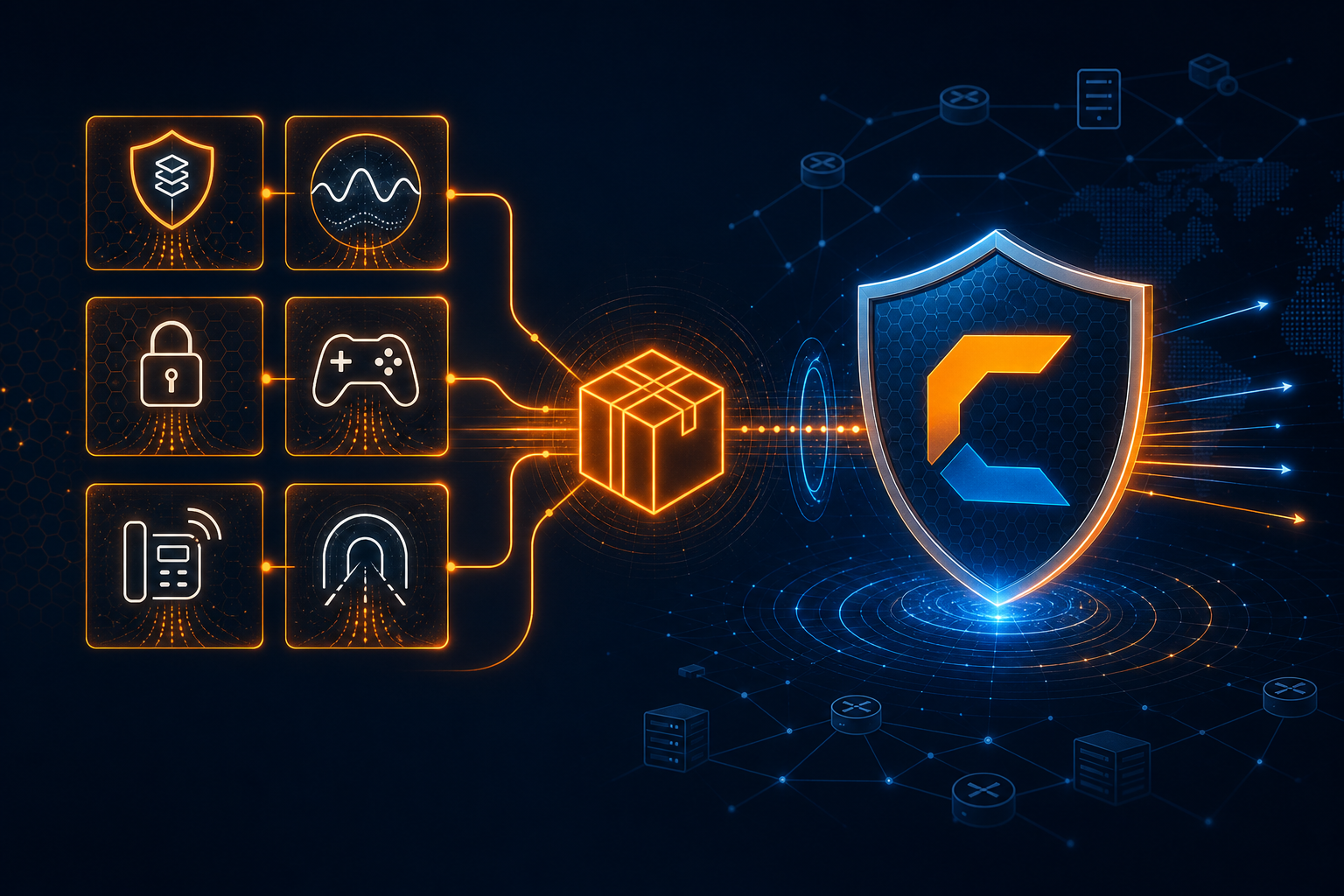
CoreEdge™ operates at a fundamentally different point in the network processing hierarchy compared to any competing product on the market. Our proprietary mitigation engine intercepts network traffic at the absolute earliest possible moment — directly at the network interface hardware, before the operating system’s network stack has any involvement whatsoever.
This is not an incremental optimization. It is a categorical architectural advantage. When a DDoS assault targeting a CoreTech-protected network arrives, the malicious packets are evaluated and discarded at silicon speed — in the range of 150 to 300 nanoseconds per packet — without consuming a single CPU cycle of the protected infrastructure. The OS, the kernel, the application stack, and the customer’s services remain entirely untouched, completely unaware that an assault of any scale is underway.
In validated production testing against real-world attack scenarios, CoreEdge™ has demonstrated the ability to process, evaluate, and discard over 10,000,000 malicious packets per second per server core with zero measurable CPU overhead on the protected infrastructure. Across our globally distributed CoreEdge™ fleet, this translates to an aggregate interception capacity that is effectively limitless in scope.
Stateful Intelligence at Inhuman Speed
What elevates CoreEdge™ beyond a simple high-speed packet filter is its deeply integrated stateful connection intelligence — a capability that operates at the same extreme speed as the raw packet interception layer itself.
Our engine maintains a continuously updated, cryptographically consistent map of every active network connection across the global CoreEdge™ network. This map tracks tens of millions of concurrent sessions in real time, spanning all protocols, all geographies, and all customer networks simultaneously. When an inbound packet arrives, our system evaluates it in nanoseconds against this global connection intelligence map. Packets that cannot be verified as part of a legitimately established network session are discarded instantly and silently.
This stateful architecture is precisely why CoreEdge™ neutralizes some of the most deceptive classes of DDoS attacks with near-perfect efficiency. Sophisticated reflection floods, spoofed ACK storms, and forged SYN-ACK cascades — attack vectors that routinely overwhelm legacy appliances — are identified and dropped before they can propagate a single byte further into the network. In documented attack scenarios, assault traffic exceeding 6,000,000 packets per second of spoofed flood traffic was absorbed and discarded with a 0% pass-through rate and an absolutely flat CPU utilization curve across the protected infrastructure.
The Performance Gap Is Now Permanent
The performance differential between CoreEdge™ and legacy hardware appliances is not merely a matter of engineering refinement. It is a consequence of a foundational architectural decision. Legacy vendors are constrained by the fundamental speed limits of the software frameworks their products are built upon. Those limits are now well understood by the industry, and they are absolute. No amount of hardware investment or firmware optimization will allow a traditional appliance-based architecture to process packets at the speed CoreEdge™ operates natively.
Our stateful interception engine also maintains this performance advantage at scale with zero-downtime configuration management. Rule updates, connection policy changes, and rate-limiting adjustments are applied instantaneously across the entire distributed network without dropping a single active connection or introducing any processing pause. For enterprise networks, ISPs, and cloud providers whose operational continuity is non-negotiable, this capability represents a qualitative shift in what it means to operate a protected network under active assault.
Protection That Scales Without Limit
CoreEdge™ supports up to 5,000,000 simultaneously tracked active connections per node, with linear horizontal scaling across our global fleet of scrubbing nodes. Our global Anycast topology ensures that attack traffic from any geographic origin is intercepted at the closest possible network edge, fracturing the assault load across dozens of geographically distributed interception points rather than allowing it to converge on a single bottleneck.
Legitimate traffic, verified against our global stateful connection map in nanoseconds, continues to flow seamlessly through our network to its destination with zero added latency and zero disruption. The war happening at the edge of the network is, for all practical purposes, completely invisible to the applications and users operating behind it.
This is what next-generation DDoS mitigation looks like at the infrastructure level. Not policy enforcement. Not threshold monitoring. Instantaneous, stateful, silicon-speed interception — before the operating system even wakes up.
Want to see this in action?
Get a live demonstration of CoreTech's DDoS mitigation platform.