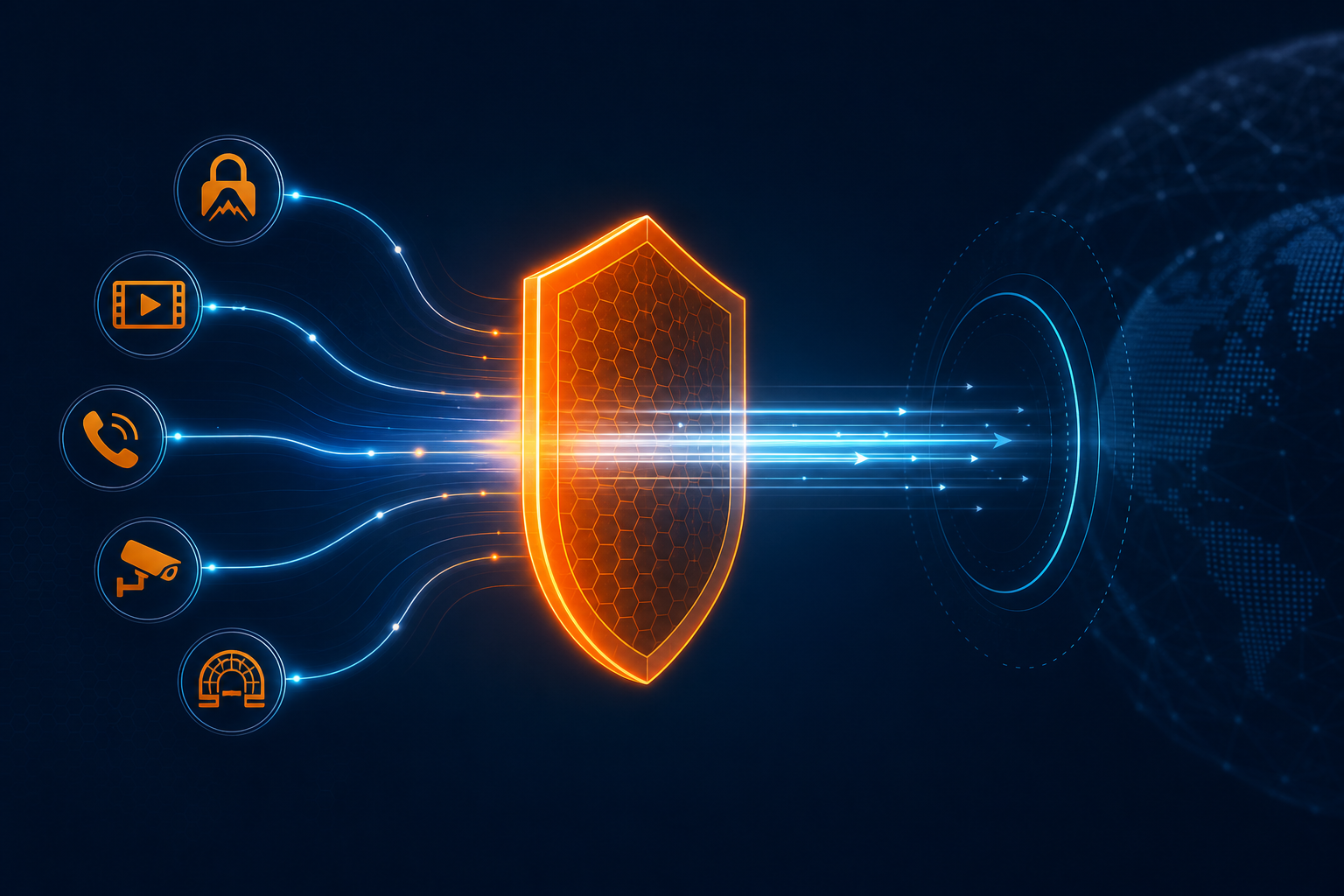
When milliseconds determine whether a network stays online or collapses under pressure, raw capacity is not enough. Modern DDoS attacks are no longer simple floods that announce themselves through obvious bandwidth spikes. They adapt, rotate, fragment, and imitate legitimate traffic patterns with increasing precision. Static threshold-based systems were built for a simpler era, where the line between normal traffic and hostile traffic was easier to draw. That line has disappeared.
CoreDetection™ was engineered for this new reality. It is not a conventional monitoring layer with artificial intelligence added on top as a marketing feature. AI is the foundation of every decision the engine makes. Every flow, every anomaly, every behavioral shift, and every mitigation trigger is evaluated through a continuously learning intelligence model designed to distinguish real users from synthetic attack traffic without forcing operators to tune endless thresholds by hand.
The result is a detection engine that does not merely ask, “How much traffic is arriving?” It asks the question that actually matters: “Does this traffic behave like it belongs here?”
Why Static Thresholds Fail Against Adaptive Attacks
Traditional DDoS detection systems operate on rigid numerical assumptions. If bandwidth crosses a configured limit, if packets per second exceed a predefined ceiling, or if connections rise above a static threshold, the system declares an attack. This logic is easy to understand, but it is dangerously incomplete.
A viral product launch can generate a sudden wave of legitimate traffic. A gaming event can create sharp bursts of UDP traffic from real players. A CDN cache purge can temporarily shift request patterns across regions. To a static system, these events can look hostile. The consequence is false mitigation, blocked users, failed sessions, and unnecessary operational panic.
Attackers understand this weakness. Instead of always launching obvious floods, modern botnets often stay below traditional thresholds while distributing traffic across residential proxies, rotating ASNs, varying packet sizes, and imitating organic user behavior. They do not need to overpower the threshold if they can avoid crossing it.
CoreDetection™ replaces this brittle model with adaptive behavioral intelligence. It continuously learns the normal rhythm of each protected destination and evaluates deviations as probabilities rather than binary events. This allows the engine to recognize both extremes: legitimate surges that should be allowed and stealthy floods that should be stopped before they become visible to legacy monitoring.
Traffic below the threshold is treated as safe, even when multiple weak signals indicate coordinated abuse.
Traffic above the threshold is treated as hostile, even when it comes from legitimate users, CDNs, or known infrastructure partners.
Every signal contributes proportional evidence: timing, protocol entropy, source behavior, historical memory, and destination-specific baselines.
Confidence rises smoothly as evidence converges, allowing early action without overreacting to legitimate traffic bursts.
AI-Driven Multi-Layer Neural Analysis
At the center of CoreDetection™ is a proprietary three-layer AI analysis pipeline. Each layer examines traffic from a different analytical perspective, producing an independent assessment of risk. The final decision emerges from the weighted consensus of all three layers, similar to how a team of senior network analysts would evaluate an incident from separate angles, but at machine speed and without fatigue.
This multi-layer design is essential because modern attacks rarely reveal themselves through a single signal. A botnet may hide its bandwidth volume, but expose itself through abnormal timing. It may randomize its source IPs, but reveal suspicious protocol entropy. It may mutate a familiar attack pattern, but retain enough structural similarity for adversarial memory to recognize the underlying technique. CoreDetection™ is built to correlate these signals instead of relying on any one of them in isolation.
Layer 1: Temporal Pattern Recognition
The first layer, known internally as Rhythm AI, performs real-time temporal pattern recognition across protected traffic flows. Every network has a natural heartbeat. Enterprise applications have business-hour cycles. Gaming platforms have evening and weekend peaks. Streaming platforms see predictable content-release surges. SaaS APIs often experience scheduled automation bursts. Even abnormal-looking spikes can be legitimate when they match the learned rhythm of the destination.
Rhythm AI builds this contextual understanding continuously. It studies how traffic grows, how quickly it decays, how sources distribute over time, and whether bursts follow patterns consistent with human or infrastructure-driven behavior. Instead of asking whether a single number is too high, it evaluates whether the shape of the traffic curve belongs to the network being protected.
This distinction is critical. Organic traffic tends to be uneven, regionally diverse, and influenced by external events. Botnet traffic often exhibits mechanical cadence, synchronized bursts, unnatural repetition, or highly coordinated ramp patterns. CoreDetection™ quantifies that difference and assigns anomaly weight accordingly.
The result is a system that can allow legitimate traffic spikes while identifying mechanical floods even when they remain below conventional bandwidth thresholds.
Layer 2: Deep Traffic Fingerprinting and Source Intelligence
The second layer constructs a multidimensional fingerprint of each anomaly. Rather than reducing traffic to bandwidth alone, CoreDetection™ evaluates protocol distribution, packet size behavior, port concentration, geographic dispersion, ASN clustering, source reputation, and the relationship between these signals over time.
This is where CoreDetection™ begins to understand the structure of an attack. A DNS amplification campaign has a different behavioral signature than a SYN flood. A Slowloris-style connection exhaustion attempt has a different rhythm than a high-rate HTTP flood. Even when attackers distribute traffic broadly, the combined fingerprint often reveals that thousands of apparently separate sources are operating as one coordinated system.
Source intelligence is equally important. CoreDetection™ maintains adaptive trust profiles for known infrastructure patterns such as CDN providers, cloud platforms, peering networks, and legitimate upstream sources. This is not a static whitelist. A trusted source behaving normally can reduce the probability of a false positive, but a trusted source behaving anomalously still receives scrutiny.
This dynamic trust model is one of the reasons CoreDetection™ can protect aggressively without punishing legitimate users. It understands that traffic origin matters, but only when origin is evaluated alongside behavior.
Layer 3: Adversarial Memory and Pattern Matching
The third layer gives CoreDetection™ long-term memory. Every confirmed attack enriches a persistent adversarial knowledge base that stores the behavioral DNA of the campaign: timing patterns, source distribution, protocol relationships, mutation characteristics, escalation behavior, and mitigation outcomes.
This memory survives restarts and strengthens over time. Recent patterns carry higher weight, while older patterns decay intelligently so that the system remains current without forgetting historically relevant threats. When attackers modify their approach, the similarity engine can still identify the underlying structure of the campaign, even if the surface indicators have changed.
In practice, this means CoreDetection™ does not treat every incident as a first encounter. A repeated attacker, a reused botnet family, or a mutated reflection campaign can be recognized faster because the system has seen its shape before. The engine does not need the mask to be identical. It recognizes the face underneath.
Pseudo-Layer 7 Intelligence Without Inline Inspection
Application-layer DDoS detection has traditionally required expensive inline inspection appliances, full packet payload visibility, or deep request analysis. That approach introduces cost, latency, privacy concerns, and operational risk. CoreDetection™ takes a different path: it infers application-layer attack behavior from flow telemetry.
By analyzing NetFlow v9, IPFIX, and sFlow metadata, CoreDetection™ can classify many Layer 7 and protocol-specific attacks without sitting inline and without inspecting sensitive payloads. DNS amplification can be inferred from UDP port behavior, response-size anomalies, and source clustering. NTP and Memcached amplification expose distinctive size and port patterns. HTTPS floods reveal themselves through connection-establishment behavior even when the payload remains encrypted. Slowloris-style attacks can be detected through ultra-low per-source rates combined with connection exhaustion characteristics.
This inference-based model allows CoreDetection™ to provide application intelligence while preserving the clean separation between the control plane and the production data path. The AI does not need to interrupt user traffic to understand what is happening.
Every classification includes confidence scoring and human-readable reasoning. Operators can see not only that an event was classified as suspicious, but why the engine reached that conclusion. This transparency matters during active incidents, where teams need explainable decisions rather than opaque alarms.
| Attack Pattern | Telemetry Signal | AI Interpretation |
|---|---|---|
| DNS Amplification | UDP/53 clustering with response-size asymmetry | Reflection behavior without inline packet inspection |
| HTTPS/TLS Flood | Connection-establishment anomalies on encrypted channels | Application pressure inferred from flow behavior |
| Slowloris | Ultra-low source rate with abnormal session persistence | Connection exhaustion strategy detected through timing |
Continuous Learning and Probabilistic Scoring
CoreDetection™ does not make brittle yes-or-no decisions at the edge of a threshold. It operates on continuous probability curves. A traffic event at moderate confidence is not ignored simply because it has not crossed a hard line. It is monitored, re-evaluated, and enriched with new evidence as the event evolves.
This eliminates the cliff problem found in traditional systems. In legacy detection, a threat at 49% of a threshold may be treated as invisible, while the same threat at 51% suddenly triggers a full mitigation response. Attackers exploit that boundary by tuning their traffic just below the trigger point. CoreDetection™ removes the boundary. Suspicion accumulates gradually, and confidence rises as independent signals converge.
Dynamic baselining reinforces this model. Each protected destination develops its own behavioral profile through exponential moving averages and adaptive historical context. A gaming server, a corporate mail server, and an API gateway are not expected to behave the same way. CoreDetection™ learns those differences automatically, reducing manual tuning while improving precision.
Autonomous Mitigation With Severity-Aware Escalation
Detection is only valuable if it leads to fast, controlled response. When CoreDetection™ confirms an attack, mitigation can begin automatically through industry-standard signaling and CoreEdge™ enforcement. The system can trigger route-level response, generate attack-specific policy updates, and escalate severity as the threat intensifies.
This escalation model is important because attacks are rarely static. A campaign may begin as a moderate probe, expand into a volumetric flood, shift vectors, and then attempt to reappear after a short pause. CoreDetection™ tracks the full lifecycle of the event, including start, escalation, update, cooldown, and end states. Mitigation is not withdrawn the moment traffic dips, because attackers often pulse attacks to exploit impatient systems. Instead, the engine uses cooldown logic to prevent route flapping and premature de-escalation.
Routine attacks do not require a 3 AM phone call. CoreDetection™ is designed to make the first response autonomously, while giving human operators the visibility and control they need for complex incidents.
Real-Time Threat Intelligence for Operators
Every detection event can be delivered through structured webhooks with detailed telemetry. Security teams receive attack bandwidth, packets per second, duration, trajectory, AI classification, source intelligence, top ASNs, countries, IP clusters, and lifecycle status. Each event carries correlation identifiers so dashboards, ticketing systems, and incident response workflows can track the attack from first detection to final resolution.
This turns DDoS detection from a black-box alert into a usable intelligence feed. Teams can understand what happened, why the AI made its decision, how the event changed over time, and what mitigation actions were applied. That operational clarity is essential for enterprises, ISPs, hosting providers, and gaming networks where availability is directly tied to revenue and trust.
Zero-Impact Architecture
CoreDetection™ operates on flow telemetry rather than inline packet inspection. It analyzes metadata copies from NetFlow v9, IPFIX, or sFlow exports, which means the AI lives in the control plane instead of the forwarding path. Production traffic does not wait for the detection engine to process a decision.
This architecture delivers four major advantages. It adds zero latency to real users. It avoids creating a single point of failure in the data path. It reduces privacy concerns because payload inspection is not required. And it scales horizontally with telemetry volume rather than forcing every packet through a centralized appliance.
Mitigation is enforced through CoreEdge™ and standard network signaling, allowing existing routers and edge infrastructure to participate in an intelligent defense system without requiring customers to redesign their entire network.
Why CoreDetection™ Matters
DDoS attackers evolve every day. They test thresholds, mutate signatures, rotate sources, and search for blind spots in static defenses. A detection engine built on fixed assumptions will always be one step behind. CoreDetection™ is different because every attack becomes training signal. Every confirmed campaign improves adversarial memory. Every prevented false positive strengthens trust modeling. Every anomaly contributes to a more precise understanding of the protected network.
Intelligent mitigation is not about reacting harder. It is about deciding better, faster, and with enough confidence to act before users feel the impact. That is the difference CoreDetection™ brings to modern DDoS defense: artificial intelligence built directly into the heart of detection, classification, escalation, and response.
When milliseconds matter, intelligence is not optional. It is the only way to stay ahead.
Want to see this in action?
Get a live demonstration of CoreTech's DDoS mitigation platform.